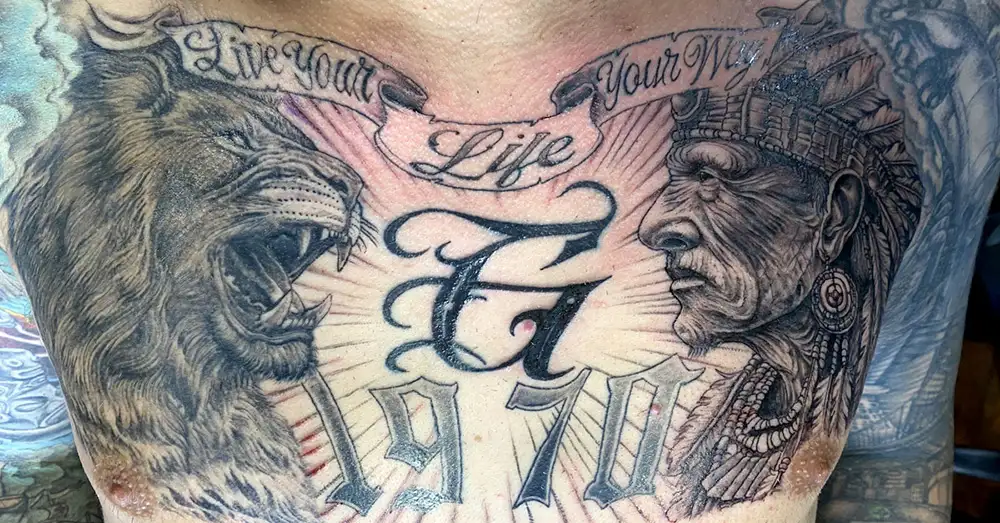
Full Chest Tattoo | Black and grey | Illustrative | Custom Design | Latino Pride
Stunning custom black-and-gray chest tattoo by Dudes Tattoos in Bronx, NY, depicting a fierce roaring lion, wise taino chief, "G 1970" initials, and motivational banners saying "Live Your Life" and "Your Way" with dramatic shading. A meaningful memorial piece showcasing expert realism in Bronx, New York. Contact requests@dudestattoos.com for your custom design.
The Origins of Puerto Rico and Boricua pride
The story of Puerto Rico's origins intertwines the ancient presence of the Taíno people with the arrival of European colonizers, marking the transition from the indigenous island of Borikén to the Spanish-founded Puerto Rico. The Taíno, an Arawak-speaking people who migrated from South America centuries earlier (around 500–1200 AD), called their homeland Borikén, meaning "Land of the Valiant Lord." They lived in organized villages.
By the late 15th century, Borikén was home to an estimated 30,000–60,000 Taíno, thriving in harmony with the island's lush mountains, rivers, and coasts. Their society emphasized community, reciprocity with nature, and oral traditions passed through generations. Petroglyphs carved into rocks at sites like Caguana in Utuado still bear witness to their cosmology.
This peaceful era ended with European contact. On November 19, 1493, during his second voyage, Christopher Columbus sighted and briefly landed on the island, naming it San Juan Bautista after Saint John the Baptist. He described its beauty but did not establish a settlement, claiming it for Spain. The Taíno initially welcomed the strangers with curiosity, offering food and guidance, unaware of the devastation to follow.
The true founding of Spanish Puerto Rico began in 1508 under Juan Ponce de León, a seasoned conquistador who had served under Columbus and helped suppress Taíno rebellions on Hispaniola. Hearing tales from Taíno traders and sailors of Borikén's gold and fertile lands,
Ponce de León sought and received permission from Spain's King Ferdinand to explore and conquer it. In August 1508, he arrived with about 50 men, native guides from Hispaniola, and supplies. Sailing along the coast,
He marveled at the island's natural harbors and resources.
Initial encounters were peaceful; Agüeybaná hosted the Spaniards,providing guides to search for gold and helping select settlement sites.
Ponce de León admired a sheltered bay on the north coast, naming it Puerto Rico ("Rich Port") for its promise of wealth. In 1509, he returned with more settlers, founding Caparra—the first permanent European settlement—near modern San Juan. He became the island's first governor, establishing the encomienda system that forced Taíno labor in gold mines and farms.
Tragically, the relationship soured rapidly. Spanish demands for tribute, forced labor, and conversion to Christianity, combined with introduced diseases like smallpox, led to massive Taíno suffering and decline. By 1511, under Agüeybaná II (who succeeded his uncle), several caciques—including Urayoán, Jumacao, and Orocobix—launched a rebellion, allying with Caribs. They killed Spanish settlers, including officer Cristóbal de Sotomayor (see rebellion page for details), and burned outposts. Ponce de León crushed the uprising with superior weapons, horses, and dogs, executing leaders and enslaving many.
Within decades, the Taíno population plummeted from tens of thousands to near extinction through violence, disease, and exploitation—by 1520–1550, few pure Taíno remained, though their descendants intermingled with Spanish and African arrivals, preserving genetic and cultural traces in modern Puerto Ricans (studies show significant Taíno ancestry in mitochondrial DNA).
This chapter reflects conquest's harsh reality: Borikén's indigenous stewards welcomed newcomers, only to face subjugation. Yet Taíno legacy endures in Puerto Rican identity—through words like "huracán" (hurricane), foods like cassava, and revived cultural pride in communities honoring Borikén's roots.