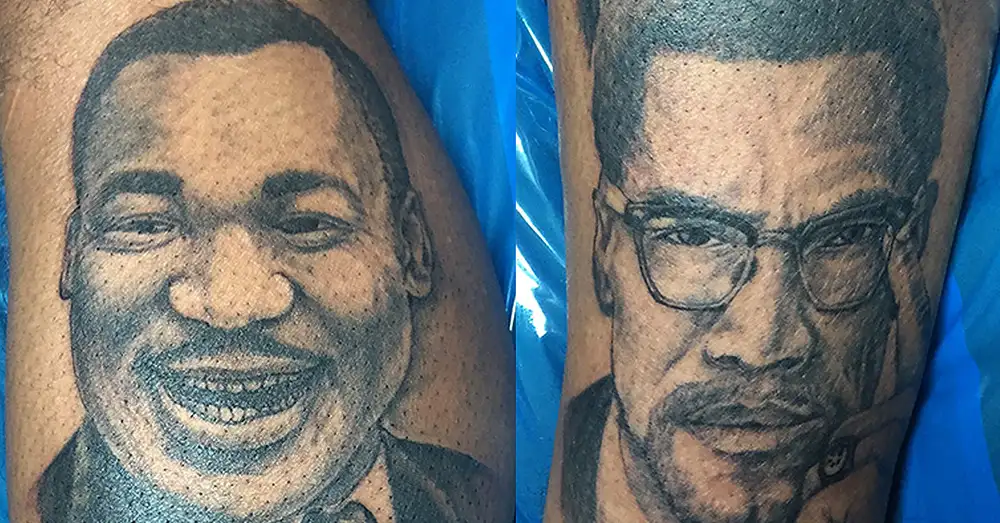
Calf Tattoo | Black and Grey | Realism | Portrait Tattoos | Dedication
Powerful custom black-and-gray portrait tattoos by Dudes Tattoos in Bronx, NY, featuring a smiling Martin Luther King Jr. and a contemplative Malcolm X with glasses and hand pose, rendered with lifelike shading for historical tribute. A meaningful civil rights memorial piece showcasing realism on New York City skin. Contact requests@dudestattoos.com for your custom tattoo.
Voices of Revolution: Martin Luther King Jr. and Malcolm X and Their Enduring Impact on American Freedom and Equal Rights
In the crucible of mid-20th-century America, two towering figures—Martin Luther King Jr. and Malcolm X—emerged as the moral and intellectual engines of the Black freedom struggle. Though often portrayed as opposites—King the apostle of nonviolence and integration, Malcolm the fiery advocate of Black nationalism and self-defense—their legacies reveal a powerful synergy that propelled the nation toward greater equality and redefined the meaning of freedom for African Americans.
Born Michael King Jr. in 1929 in Atlanta, Martin Luther King Jr. rose to prominence as a Baptist minister and leader of the Southern Christian Leadership Conference (SCLC). Inspired by Gandhi and Christian love, he championed nonviolent resistance—boycotts, marches, sit-ins—to expose injustice and appeal to America's conscience. His leadership in the 1955–1956 Montgomery Bus Boycott launched the modern Civil Rights Movement, galvanizing national attention. The 1963 March on Washington, where he delivered his iconic “I Have a Dream” speech, crystallized the vision of racial harmony and equality under law. King's moral authority pressured lawmakers: his campaigns in Birmingham and Selma directly contributed to the passage of the Civil Rights Act of 1964 (ending segregation in public places and employment discrimination) and the Voting Rights Act of 1965 (dismantling barriers to Black voting). By his 1968 assassination, King had shifted toward economic justice and anti-war activism, linking racial equality to broader human rights.
Malcolm X, born Malcolm Little in 1925 in Omaha, rose from prison to become the Nation of Islam's most charismatic spokesman. Rejecting integration as futile in a racist society, he preached Black self-reliance, pride, and—if necessary—self-defense “by any means necessary.” His sharp critiques of white supremacy and calls for Black nationalism challenged complacency and empowered millions to embrace cultural identity and economic independence. Though initially critical of King's nonviolence, Malcolm's 1964 pilgrimage to Mecca transformed him; he embraced universal brotherhood and began aligning more closely with global human rights. His assassination in 1965 cut short this evolution, but his emphasis on Black dignity, psychological liberation, and international solidarity influenced later movements like Black Power.
Their approaches were complementary, not contradictory. As historian Peniel Joseph argues in The Sword and the Shield, Malcolm's radicalism created political space: his militancy made King's moderate demands seem reasonable to white moderates and lawmakers, accelerating legislative wins. King's moral victories, in turn, validated Malcolm's calls for dignity. Together, they forced America to confront its contradictions—pushing beyond legal equality toward deeper freedoms: economic justice, cultural pride, and human dignity.
Their combined impact endures. The Civil Rights Acts they helped forge dismantled Jim Crow, expanded voting access, and opened doors in education, employment, and housing. Yet their visions remain unfinished—echoing in modern struggles for police reform, economic equity, and racial reckoning. King dreamed of a beloved community; Malcolm demanded unapologetic Black power. Both insisted freedom is not given but fought for, and equality is not abstract but lived.
In the words of James Baldwin, by the end, “there was practically no difference between them.” Their shared mission—radical Black dignity, full citizenship, and justice—continues to inspire the ongoing American pursuit of “liberty and justice for all.”