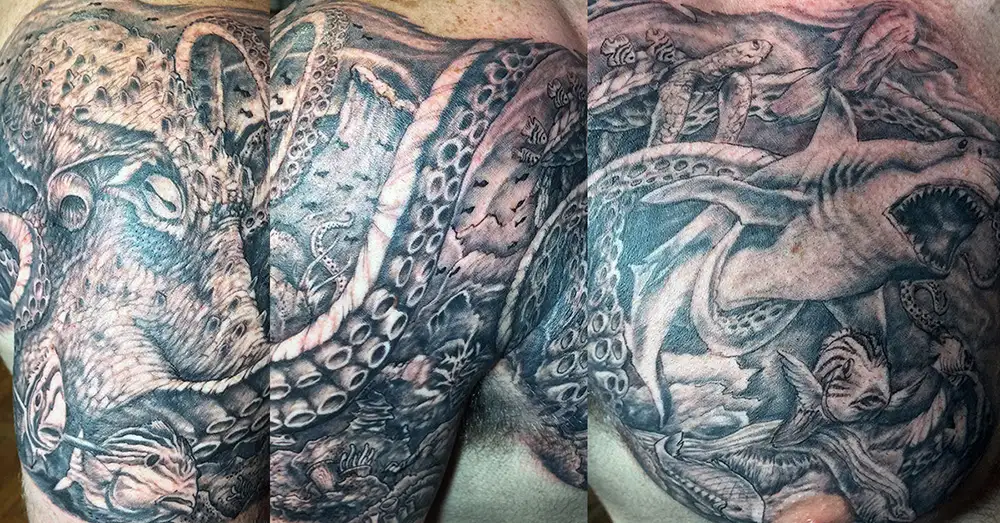
Chest & Arm Tattoo | Black and Grey | Realism | Illustrative | Sea life
Fun custom color leg tattoo by Dudes Tattoos in Bronx, NY, portraying a chibi version of Guts from Berserk with spiky hair, red eyes, armored outfit, and massive sword, blending cute anime style with fierce details. A playful manga tribute showcasing vibrant shading on New York City skin. Contact requests@dudestattoos.com for your custom tattoo.
Terror of the Deep to Scientific Marvel: The Legendary History of Sea Monsters Like Sharks and Octopuses
For thousands of years, the ocean has been humanity’s greatest frontier of fear and fascination. Before modern science mapped the seas, sailors, fishermen, and coastal peoples told stories of colossal, intelligent, and often malevolent creatures lurking beneath the waves. Among the most enduring legends were the kraken (a gigantic octopus or squid) and the sea serpent—but two real animals, the shark and the octopus, anchored many of these myths and were themselves transformed into monsters in folklore, art, and early natural history.
The Shark: From Sacred Predator to Man-Eating Demon
Sharks appear in human culture almost as soon as we took to the water. Ancient Polynesian seafarers revered them as aumakua (guardian spirits or deified ancestors), carving shark-tooth weapons and tattoos as symbols of strength and protection. In Hawaiian legend, the shark god Kamohoaliʻi ruled the seas and protected voyagers. Yet in many other cultures, sharks became omens of doom. The Romans called them canis marinus (“sea dog”), associating them with treachery. By the Middle Ages, European sailors described sharks as devourers of shipwrecked men—stories amplified after the Age of Sail, when long voyages increased encounters with oceanic whitetips and tigers.
The modern “man-eater” myth exploded in the 20th century. The 1916 Jersey Shore shark attacks (four fatal bites in 12 days) sparked national panic in the United States. Peter Benchley’s 1974 novel Jaws (and Steven Spielberg’s 1975 film) crystallized the great white shark as the archetypal sea monster—silent, relentless, and unstoppable. The film’s success led to decades of fear-driven shark culling, despite sharks killing only about 5–10 people globally per year while humans kill tens of millions of sharks annually.
Today, scientific understanding has shifted the narrative. Sharks are apex predators vital to marine ecosystems, with over 500 species exhibiting complex behaviors—cooperative hunting in hammerheads, social learning in lemon sharks, and even curiosity toward divers.
The Octopus: From Ship-Sinking Kraken to Master of Disguise
The kraken legend, first documented in 12th-century Norse sagas and popularized in 18th-century accounts by Norwegian bishop Erik Pontoppidan, described a creature so large it could drag entire ships to the depths by wrapping its arms around them. Sailors claimed to have seen “islands” rise from the sea—actually the backs of giant squid or colossal octopuses. The 1870s discovery of giant squid carcasses (Architeuthis) in Newfoundland and the 2004 first live footage of one confirmed that enormous cephalopods existed, lending credence to centuries of tales.
Octopuses themselves were long demonized. In Greco-Roman myth, Scylla (a multi-headed sea monster) and the Hydra echoed multi-limbed cephalopod imagery. Medieval bestiaries depicted octopuses as deceitful devils; Polynesian and Pacific Islander stories sometimes portrayed them as tricksters or shapeshifters. Yet many cultures also respected their intelligence—Hawaiian legends describe octopuses as clever escape artists and guardians of hidden knowledge.
Modern science has revealed the octopus as one of Earth’s most extraordinary creatures: distributed brains in each arm, color-changing camouflage via chromatophores, problem-solving (unscrewing jars, escaping tanks), tool use (coconut shells as shelters), and short, dramatic lifespans tied to semelparity (reproduction followed by death). Documentaries like My Octopus Teacher (2020) transformed the animal from monster to empathetic being, shifting public perception dramatically.
From Myth to Reality
Both sharks and octopuses transitioned from legendary sea monsters to subjects of awe and conservation. Once feared as devourers or ship-wreckers, they are now recognized as vital to ocean health—sharks as top predators, octopuses as intelligent sentinels of ecosystem change. The stories we once told to explain the unknown now serve as cautionary tales about fear, misunderstanding, and the importance of knowledge in replacing myth with wonder.