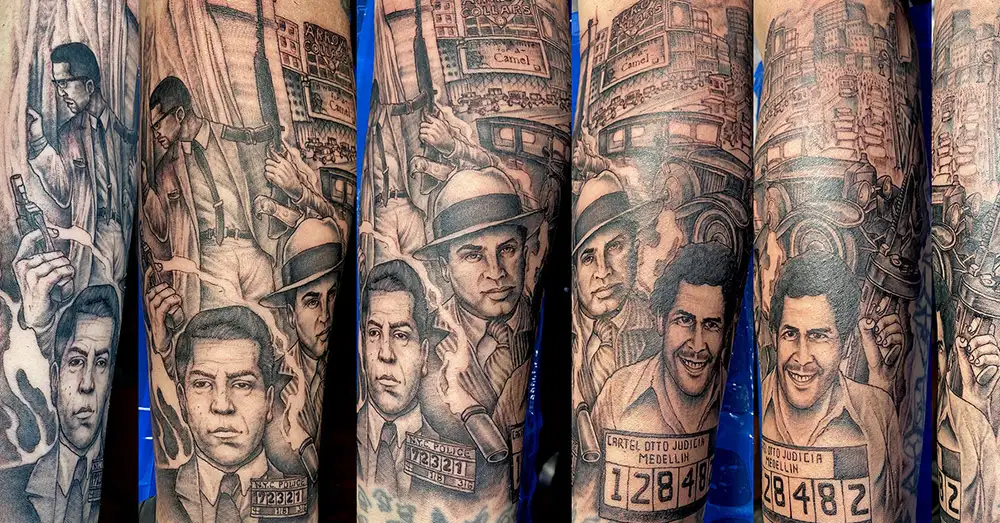
Forearm Tattoo Sleeve | Black and Grey | Realism | Portraits | Dedication
Epic custom black-and-gray arm sleeve tattoo by Dudes Tattoos in Bronx, NY, featuring detailed portraits of iconic gangsters with mugshot numbers, guns, urban backdrops, and dramatic shading for a historical crime narrative. A bold thematic piece showcasing expert realism and storytelling on New York City skin. Contact requests@dudestattoos.com for your custom tattoo.
The Mafia, “By Any Means Necessary,” and Malcolm X: When Ruthlessness Crossed Worlds
The Mafia—America’s most mythologized criminal syndicate—did not invent the phrase “by any means necessary,” but it lived it long before the words became a rallying cry for civil rights. From the late 19th century through the mid-20th, Sicilian and Italian-American organized crime groups operated under a brutal pragmatism: achieve power, protect the family, eliminate threats, and secure profit through whatever tools were required—bribery, intimidation, murder, political corruption, labor racketeering, bootlegging, gambling, narcotics. The unspoken rule was simple: the ends justified the means. Loyalty was absolute, betrayal was death, and hesitation was weakness.
This ethos was codified in the unwritten code of omertà (silence) and the ruthless efficiency of figures like Lucky Luciano, who in the 1930s restructured the chaotic warring families into the modern Commission, creating a corporate-style syndicate that ran like a shadow government. By the 1950s, the Mafia controlled unions, construction, waste disposal, and much of the East Coast waterfront. When law enforcement or rivals stood in the way, violence was not the last resort—it was standard procedure. “Do what you have to do” was the operating principle, whether that meant fixing juries, bombing competitors’ businesses, or assassinating witnesses.
Across the racial and cultural divide, Malcolm X adopted the very same four words—“by any means necessary”—as the closing line of his most famous speeches in 1964, most notably at the founding rally of the Organization of Afro-American Unity on June 28, 1964. For Malcolm, the phrase was a declaration of uncompromising self-defense and liberation: if peaceful protest and appeals to conscience failed to end white supremacy, Black people had the right—indeed the duty—to protect themselves “by any means necessary.” He made clear he was not advocating random violence, but refusing to rule out armed self-defense when the state and vigilantes used terror against Black communities.
The linguistic and philosophical parallel is striking. Both the Mafia and Malcolm X, in their vastly different contexts, rejected passivity and moral posturing in the face of existential threats. The Mafia used “by any means” to preserve illicit power and family survival within a hostile society; Malcolm used it to demand justice and physical safety in a society that routinely denied both to Black Americans. Both worldviews were born of marginalization—one ethnic, one racial—and both refused to wait for permission or fairness from the dominant power structure.
The phrase itself has older roots. It echoes Vladimir Lenin’s 1918 slogan “by all means necessary” in revolutionary pamphlets and appears in various militant and nationalist movements of the early 20th century. Malcolm most likely encountered it through his study of global anti-colonial struggles and his time in the Nation of Islam, where Elijah Muhammad taught uncompromising separatism. Yet its adoption by Malcolm gave it moral urgency and global resonance—turning a pragmatic gangster creed into a revolutionary call.
Ironically, the Mafia and Malcolm X would have been mortal enemies in practice. The Mafia profited from exploiting Black neighborhoods through numbers rackets, narcotics, and predatory lending; Malcolm repeatedly denounced organized crime as a tool of white oppression. Yet the shared language—“by any means necessary”—reveals a deeper truth: when survival or justice feels impossible through conventional channels, even radically different groups reach for the same uncompromising logic.
Today the phrase lives on in hip-hop lyrics, protest chants, and political rhetoric, stripped of its original contexts but carrying the weight of both the Mafia’s cold pragmatism and Malcolm’s fierce moral claim. It remains one of the most potent—and contested—declarations in American history.