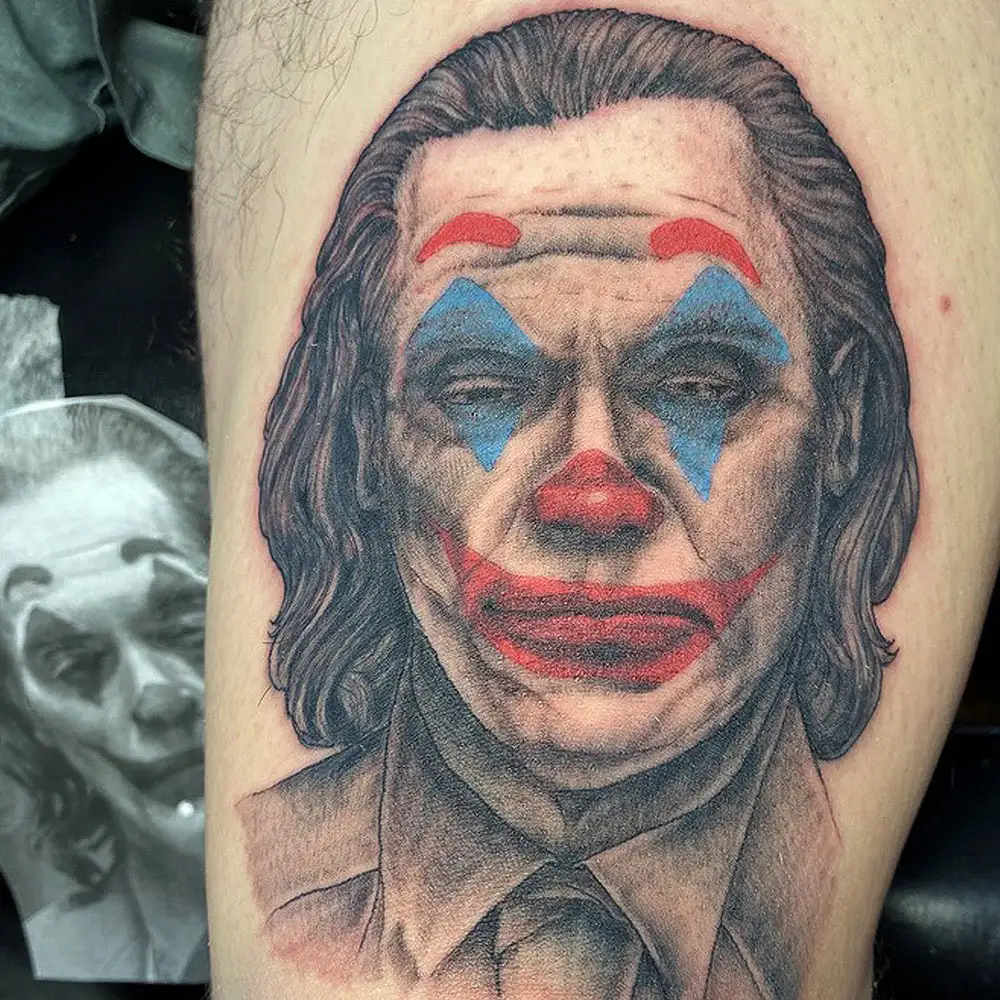
Calf Tattoo | Full Color | Realism | Illustrative | Portrait | DC Comics
Striking custom color arm tattoo by Dudes Tattoos in Bronx, NY, depicting Joaquin Phoenix's Joker with green hair, red smile, blue eye accents, red nose, and detailed suit, blending realism and comic style. A fan-favorite DC villain piece showcasing bold hues and precision on New York City skin. Contact requests@dudestattoos.com for your custom tattoos.
Chaos Incarnate: The Joker's Evolution from Comic Book Menace to Icon
In the shadowy alleys of Gotham City, no villain has haunted Batman's psyche like the Joker—a grinning harbinger of anarchy whose laugh echoes through decades of pop culture. Created by Bill Finger, Bob Kane, and Jerry Robinson, the Clown Prince of Crime debuted in Batman #1 (April 25, 1940) as a cunning psychopath, inspired by Conrad Veidt's disfigured grin in the 1928 film The Man Who Laughs. Initially a one-off killer who used Joker venom to leave victims with rictus smiles, editorial intervention saved him from death in his first story, birthing Batman's ultimate foil—a mirror of chaos to the Dark Knight's order.
The Joker's early comic incarnations were murderous and macabre. In the 1940s Golden Age, he orchestrated elaborate heists and murders, clashing with Batman in tales like "The Joker Returns" (Batman #1). By the 1950s Silver Age, the Comics Code Authority softened him into a goofy prankster—pulling harmless capers with oversized props in stories like "The Joker's Utility Belt" (Batman #86, 1954). This campy era peaked with Cesar Romero's portrayal in the 1966 Batman TV series and film, where the Joker was a flamboyant trickster with a painted mustache, hamming it up for laughs amid "Pow!" and "Bam!" fights.
The 1970s Bronze Age revived his darkness, thanks to writers like Dennis O'Neil and Neal Adams in "The Joker's Five-Way Revenge" (Batman #251, 1973), reestablishing him as a homicidal maniac. This paved the way for iconic arcs: Alan Moore and Brian Bolland's Batman: The Killing Joke (1988) offered a tragic origin—a failed comedian falling into chemicals after a botched heist, paralyzing Barbara Gordon and probing the thin line between sanity and madness. The 1980s–1990s saw him in grim tales like A Death in the Family (1988), where fans voted to kill Robin (Jason Todd), solidifying his lethality.
Cinematic incarnations amplified his menace. Jack Nicholson's Jack Napier in Tim Burton's Batman (1989) was a gangster turned acid-scarred showman, blending camp with noir. Mark Hamill's voice in Batman: The Animated Series (1992–1995) delivered a chilling cackle, influencing games like the Arkham series. Heath Ledger's anarchic agent in Christopher Nolan's The Dark Knight (2008) earned a posthumous Oscar, portraying a scarred terrorist who "just wants to watch the world burn," redefining the character as a philosophical nihilist.
Later versions diversified: Jared Leto's tattooed gangster in Suicide Squad (2016) drew mixed reviews for its edginess. Joaquin Phoenix's Arthur Fleck in Joker (2019) humanized him as a mentally ill outcast descending into madness amid societal neglect, winning an Oscar and sparking debates on empathy for villains. Recent comics like Batman: Three Jokers (2020) explored multiple incarnations—Criminal, Clown, Comedian—suggesting fractured psyches.
Through 80+ years, the Joker embodies chaos's allure: from killer clown to tragic antihero, his adaptability mirrors societal fears—madness, anarchy, inequality. In movies like The Batman (2022) with Barry Keoghan's scarred tease or animated revivals, he remains Batman's eternal shadow, proving some villains are timeless.