Dudes Tattoos Logo - Micro

Dudes Tatto​​os

Tattoo Portfolio Gallery - Page 16

Next   Prev

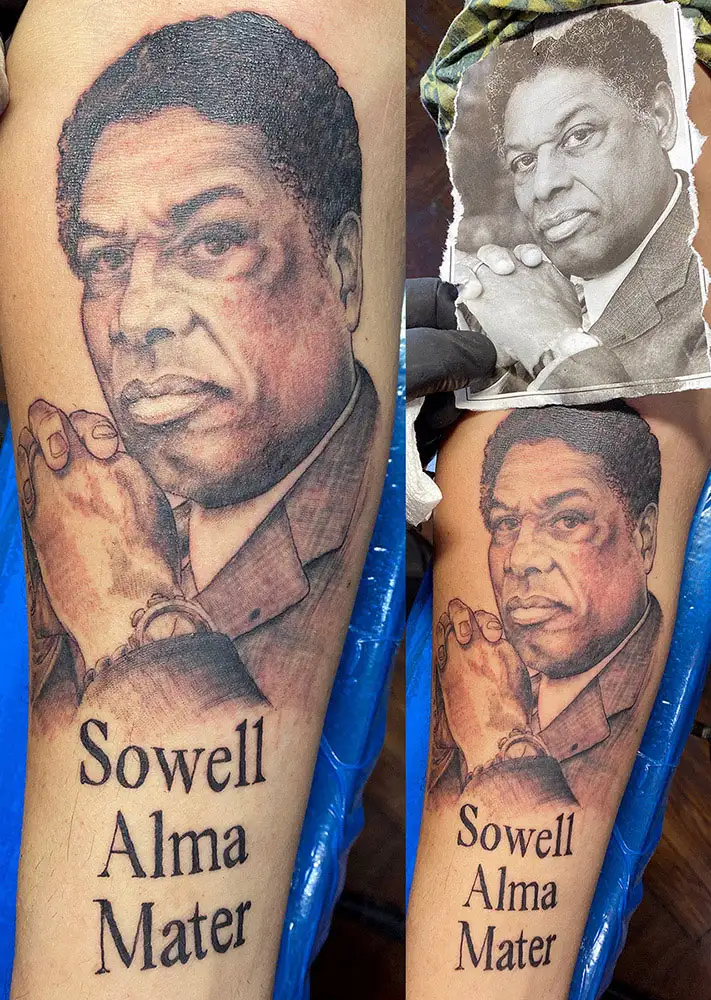
The Honoring of Thomas Sowell

Forearm Tattoo | Black and Grey | Realism | Portrait | Scholar

Masterful custom black-and-gray arm tattoo by Dudes Tattoos in Bronx, NY, featuring a lifelike portrait of economist Thomas Sowell in contemplative pose, accompanied by "Sowell Alma Mater" lettering and expert shading. A meaningful tribute piece honoring intellectual legacy on New York City skin. Contact requests@dudestattoos.com for your custom tattoo.

The Mind That Shaped Modern Conservatism: Thomas Sowell and His Enduring Achievements

Thomas Sowell, born June 30, 1930, in Gastonia, North Carolina, rose from humble beginnings—orphaned young, raised in Harlem, and dropping out of high school—to become one of the 20th and 21st centuries’ most influential economists, social theorists, and public intellectuals. A self-described “unrepentant Marxist” in his youth, Sowell’s intellectual journey led him to reject collectivism after witnessing its failures firsthand, forging instead a rigorous, data-driven defense of free markets, individual liberty, and empirical skepticism toward government intervention. 

Sowell earned a bachelor’s degree magna cum laude from Harvard (1958), a master’s from Columbia (1959), and a Ph.D. in economics from the University of Chicago (1968), studying under Nobel laureates like Milton Friedman and George Stigler. His early academic career included teaching stints at Cornell, UCLA, and Amherst before he joined the Hoover Institution at Stanford in 1980, where he remains a senior fellow. 

His prolific output—over 45 books, hundreds of columns, and thousands of essays—covers economics, race, education, culture, and political philosophy. Landmark works include:

Knowledge and Decisions (1980) — a profound exploration of how dispersed knowledge in society makes centralized planning inherently flawed, building on Friedrich Hayek’s insights.

A Conflict of Visions (1987) — perhaps his most influential book, contrasting the “constrained” (realistic, tragic) vision of human nature (emphasized by conservatives) with the “unconstrained” (utopian, perfectible) vision favored by progressives. This framework remains a cornerstone for understanding ideological divides.


Basic Economics (2000, updated through 5th edition 2014) — a 700+ page primer written without graphs or equations, explaining economic principles through clear prose and real-world examples; widely used in classrooms and cited as one of the best introductions to economics ever written.

Black Rednecks and White Liberals (2005) — a provocative collection arguing that many cultural patterns attributed to race in America actually stem from regional and class-based behaviors transplanted from British borderlands, challenging conventional narratives on race and culture.


Discrimination and Disparities (2018, expanded 2019) — a data-heavy rebuttal to claims that disparities in outcomes are primarily the result of discrimination, emphasizing factors like culture, geography, family structure, and individual choices.

Sowell’s syndicated column ran in over 150 newspapers for decades, and his frequent appearances on shows like Firing Line (with William F. Buckley Jr.) and later podcasts helped popularize free-market ideas among general audiences. He received the National Humanities Medal in 2002 from President George W. Bush and the Bradley Prize in 2004. His Hoover Institution page, YouTube lectures, and books continue to reach millions, especially younger conservatives and libertarians seeking rigorous alternatives to progressive orthodoxy. 

Critics accuse him of cherry-picking data or downplaying systemic racism, yet defenders praise his insistence on evidence over ideology and his willingness to challenge sacred cows on both sides. At 95 (as of 2025), Sowell remains active, publishing essays and books that continue to shape debates on affirmative action, minimum wage laws, welfare policy, and the dangers of “visionaries” who believe they can engineer society from above. 

Thomas Sowell’s greatest achievement may be his lifelong demonstration that clear thinking, empirical rigor, and intellectual courage can cut through dogma—leaving a legacy that outlives any single policy or election cycle. 

Further reading & sources

 • Thomas Sowell on Wikipedia 
Thomas Sowell – Hoover Institution 
A Conflict of Visions – Amazon 
Basic Economics – Thomas Sowell’s Official Site 
Thomas Sowell on Race and Culture – YouTube Lectures 
National Humanities Medal – NEH

Back to Tattoo Gallery Contact Us - Fill a Request Form