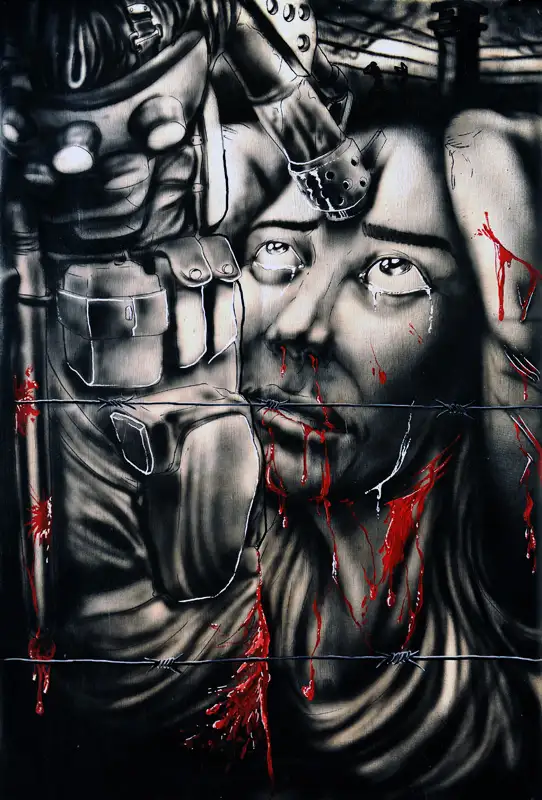
Intense anti-war tattoo artwork by Dudes Tattoos in Bronx, NY, showing a soldier aiming a gun at a crying, blood-dripping victim above barbed wire, with a hanging figure below in stark black-and-white. Ideal for custom dark or symbolic tattoos in New York City. Contact requests@dudestattoos.com for inquiries.
Enduring the Unthinkable: Vietnam POWs' Survival and Journey Home
In the sweltering cells of North Vietnam's infamous Hỏa Lò Prison—sarcastically dubbed the "Hanoi Hilton" by captives—American prisoners of war (POWs) faced a hellish ordeal during the Vietnam War (1955–1975). Captured primarily as downed pilots, these men endured years of isolation, torture, and deprivation, yet their unbreakable spirit, clandestine communication, faith, and camaraderie forged paths to survival. From 1964 to 1973, over 660 U.S. military personnel were imprisoned in the North, with 591 released in Operation Homecoming following the Paris Peace Accords. Their stories, drawn from declassified reports and personal memoirs, reveal profound resilience amid one of history's most brutal captivities.
The nightmare often began with ejection from flaming aircraft. Lieutenant Junior Grade Everett Alvarez Jr., the first U.S. pilot captured on August 5, 1964, during a raid on Hon Gay, spent nearly nine years in captivity—the longest-serving POW. Shot down in his A-4 Skyhawk, Alvarez was paraded through hostile crowds, interrogated relentlessly, and confined in solitary for months. Like many, he faced "the ropes"—arms twisted behind the back until shoulders dislocated—or beatings with fan belts. Yet Alvarez clung to hope, memorizing fellow prisoners' names and drawing strength from his Catholic faith, reciting prayers silently to combat despair.
Survival hinged on ingenuity and solidarity. Prisoners developed the "tap code," a 5x5 grid matrix (excluding K) tapped on walls to communicate covertly. Admiral James Stockdale, shot down in 1965 and held for over seven years, led the resistance as senior officer. Under his guidance, POWs adhered to the U.S. Military Code of Conduct: name, rank, service number, date of birth only—resisting propaganda confessions despite torture. Stockdale, who endured 15 solitary confinements and leg irons, later reflected in his memoir how mutual support turned isolation into a "civilization of heroes." Faith played a pivotal role; many, like Navy Captain Eugene "Red" McDaniel, tortured for refusing to denounce America, found solace in scripture, crediting divine intervention for endurance.
Tales of defiance abound. Senator John McCain, captured in 1967 after his A-4 was hit over Hanoi, rejected early release offers to avoid propaganda value, enduring broken limbs without proper care and years in solitary. His humor and leadership buoyed others. Army Special Forces Major James Rowe, held by the Viet Cong from 1963, escaped after five years of jungle cages, starvation, and mock executions, using survival training to feign illness before overpowering guards.
Conditions worsened in camps like "the Zoo" or "Briarpatch," with meager rice rations, rat-infested cells, and no medical aid—leading to diseases like beriberi. Yet prisoners organized secret classes on history and math, exercised covertly, and celebrated holidays with smuggled goods. The 1970 Son Tay Raid, a failed U.S. rescue attempt, paradoxically improved treatment as North Vietnam feared escalation.
The turning point came with intensified U.S. bombing in 1972 (Operation Linebacker II), forcing negotiations. On January 27, 1973, the Paris Accords ended direct U.S. involvement, mandating POW release. Operation Homecoming began February 12, with C-141 Starlifters airlifting groups from Gia Lam Airport to Clark Air Base, Philippines. Alvarez, McCain, Stockdale, and others—emaciated but defiant—stepped onto free soil, greeted by cheers and medical care. By April, all 591 were home, though many battled lifelong PTSD.
Their return sparked national reflection; parades honored them as heroes, contrasting the anti-war sentiment that alienated other vets. Memoirs like Alvarez's Chained Eagle and Stockdale's In Love and War immortalized their saga, influencing policy on POW treatment. Today, their legacy endures in museums and veteran support, a testament to human endurance against fate's cruelest threads.