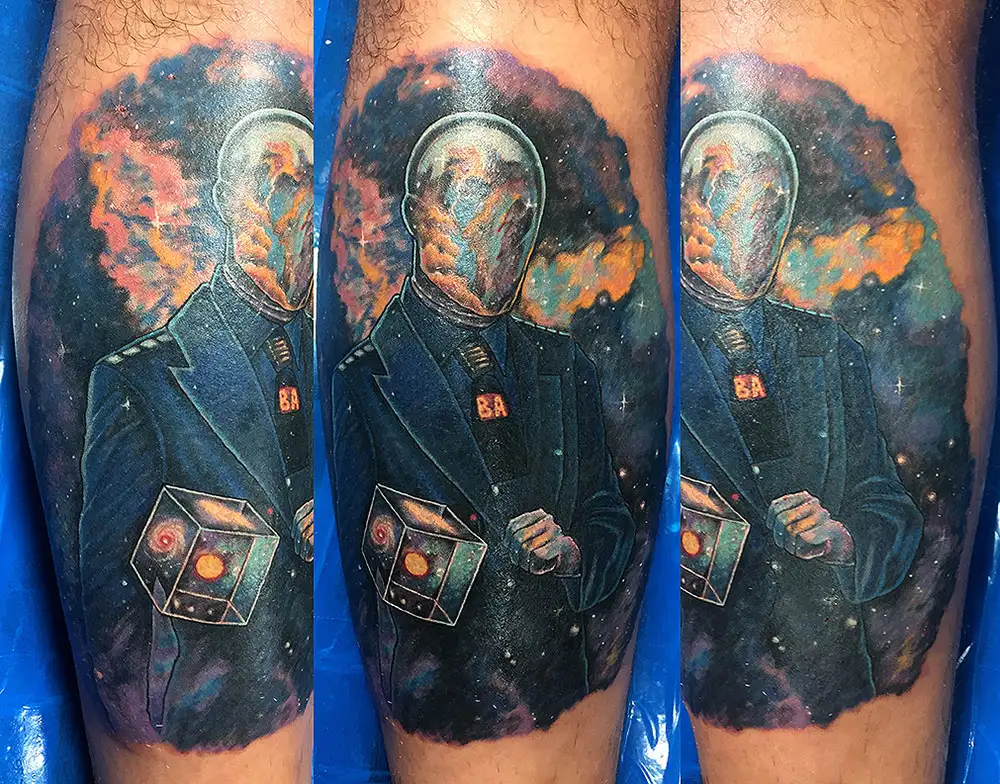
Calf Tattoo | Full Color | Illustrative | Sci-fi tattoo
Stunning custom color Calf tattoo by Dudes Tattoos in Bronx, NY, portraying a suited astronaut with a nebula-filled helmet head, holding a cosmic cube of galaxies amid a starry void with intricate shading and aurora effects. A unique sci-fi surreal piece highlighting vibrant realism on New York City skin. Contact requests@dudestattoos.com for your custom tattoo.
The Vanguard of the Stars
In the freezing predawn of a Florida launchpad in late 2026, a sleek Starship stands ready. Not for astronauts yet — but for its first passengers: dozens of Tesla Optimus humanoid robots. As Elon Musk announced in March 2025, these AI-powered companions will ride the fully reusable Starship to Mars, tasked with the dangerous groundwork of building the first off-world civilization. They will unload cargo, assemble solar arrays, dig regolith for habitats, and test life-support systems long before any human sets foot on the Red Planet — potentially as early as 2029.
This is not distant speculation. Optimus, already walking factory floors and learning tasks through vision-language-action models, is designed exactly for this: dexterous, tireless labor in environments lethal to humans. Musk has made clear the robots will prepare infrastructure so the first human Martians arrive to ready-made homes rather than barren rock.
Just weeks earlier, on 5 January 2026 at CES in Las Vegas, Boston Dynamics unveiled the production version of its fully electric Atlas humanoid. Gone is the old hydraulic clunker; the new Atlas is compact, fluid, and powerful — 56 degrees of freedom, able to lift 50 kg, cartwheel, recover from falls, and operate autonomously in temperatures from −20 °C to +40 °C while swapping its own batteries. Initial fleets ship to Hyundai and Google DeepMind in 2026 for industrial work, but its rugged, water-resistant design and DeepMind-trained AI make it perfect for lunar construction zones or Martian dust storms.
NASA’s own Valkyrie humanoid — a 6 ft 2 in, 300 lb electric robot built for “degraded and dangerous environments” — has already been tested for Artemis lunar missions and long-term Mars concepts. Swarms of smaller AI explorers, like Intuitive Machines’ lunar prospectors, are mapping ice and building 3D-printed landing pads today.
The convergence became official on 3 February 2026 when Musk merged SpaceX and xAI into a $1.25 trillion powerhouse. The plan: launch up to one million solar-powered satellites as orbital AI data centers. Musk explained, “Within two to three years, the lowest-cost way to generate AI compute will be in space… enabling self-growing bases on the Moon, an entire civilisation on Mars and ultimately expansion to the universe.”
On the Moon, the transformation is already visible in concept. Starship’s 100+ tonne cargo capacity will deliver robot swarms that learn collectively through cloud robotics, 3D-map craters, drill for water ice, and tele-operate from lunar orbit — exactly as described in early lunar base studies. Companies like Figure AI, with their fully autonomous Figure 03 humanoids, are racing to join the effort.
By the early 2030s these AI pioneers will have built the first habitats, mined propellant from lunar ice, and turned Martian regolith into bricks. Humans will follow not as fragile explorers but as settlers stepping into ready-made outposts maintained by tireless robotic partners.
The age of lonely human spaceflight is ending. The age of symbiotic human-AI exploration has begun — and the robots are already on the launchpad.