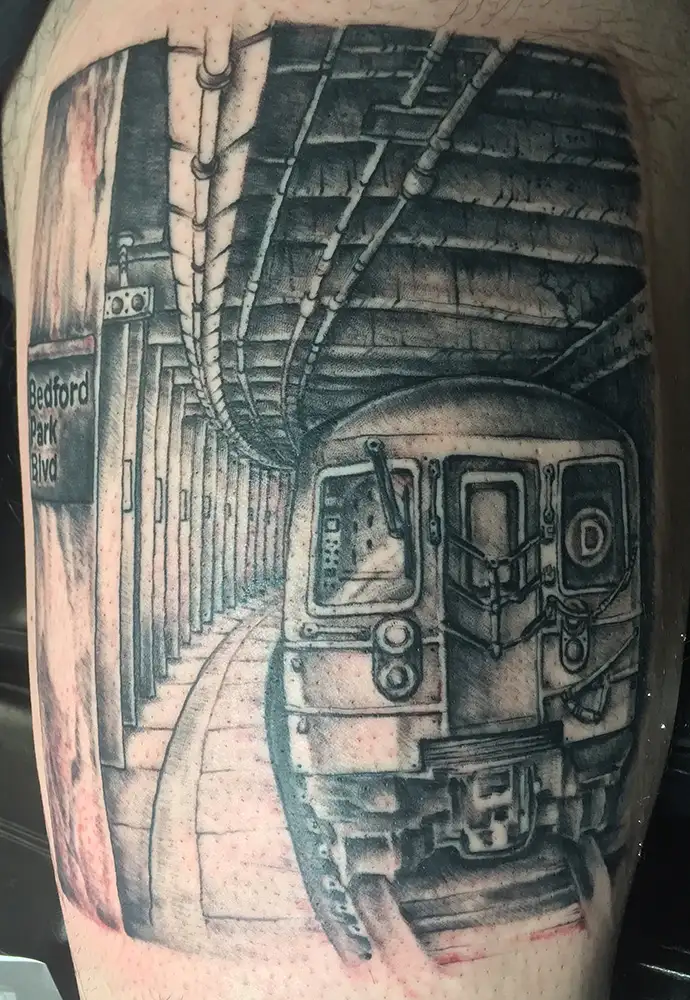
Thigh Tattoo | Black and Grey | Illustrative | Scenic tattoo
Impressive custom black-and-gray arm tattoo by Dudes Tattoos in Bronx, NY, depicting a immersive NYC subway scene with the Bedford Park Blvd station sign, oncoming D train, overhead pipes, and perspective shading for urban realism. A nod to Bronx roots and city life in New York City ink. Contact requests@dudestattoos.com for your custom tattoo.
Rails of Resilience: The Historic Journey of the Bronx Train System
Long before the Bronx became the vibrant “Boogie Down,” its transportation lifeline was a noisy, smoke-belching elevated railway that literally lifted the borough into the modern age. The story of the Bronx train system is one of steel, steam, and stubborn survival — from the iconic Third Avenue Elevated (“the Bronx El”) to the underground and above-ground subway lines that still carry millions today.
It began in the 1880s. In 1886 the Third Avenue El crossed the Harlem River on a double-deck swing bridge, bringing the first rapid transit into what was then called the “Annexed District.” By 1901 the line reached Fordham Road, and wooden “El” cars rattled past tenements and farmland. The elevated trains triggered an explosive population boom — the Bronx grew nearly fivefold in two decades as working families could now commute to Manhattan jobs in minutes instead of hours. View historical photo of Third Avenue Elevated tracks
By the early 1900s the private Interborough Rapid Transit Company (IRT) took control. The real revolution arrived with the Dual Contracts of 1913. New subway tunnels and elevated extensions pushed deep into the Bronx. The Jerome Avenue Line (today’s 4 train) opened in 1918, the Pelham Line (6 train) followed, and the IND Concourse Line (D train) arrived in 1933. For the first time, the Bronx had true underground rapid transit.
The trains themselves became legends. The classic Low-Voltage (Lo-V) cars — built 1916–1925 — were the workhorses of the IRT. These all-steel, low-voltage-control cars served Lexington and Seventh Avenue lines and, in their final years, shuttled along the remaining Third Avenue El in the Bronx until retirement in 1969. View vintage Lo-V cars photo
In the 1970s and 80s the bright-red Redbird fleet (R33 and R36 cars) became the face of Bronx commuting — rumbling over elevated tracks on the 2, 5, and 6 lines, their distinctive rounded roofs and bright paint instantly recognizable to every rider. View Redbird train photo
The old Third Avenue El — once the backbone of the Bronx — met its end on April 29, 1973. Crowds gathered for the final run; the next day the Bx55 bus replaced it. Sections south of 149th Street had already been dismantled in the 1950s as the city shifted fully underground. The last elevated remnants in Manhattan disappeared, but the Bronx kept (and still keeps) miles of elevated track on the 2, 4, 5, and 6 lines — a living reminder of its elevated origins.
In 1968 the city unified all transit under the Metropolitan Transportation Authority (MTA), creating the modern system we know today. Decades of modernization followed: new cars, signal upgrades, and accessibility improvements. Yet the soul of the Bronx rails remains in those steel girders and rumbling wheels that have carried generations to work, school, and home.
From steam-powered Els that opened the borough to the Lo-V and Redbird legends that defined its 20th-century identity, the Bronx train system is more than tracks and timetables — it is the iron thread that stitched a rural district into one of New York’s most dynamic boroughs.