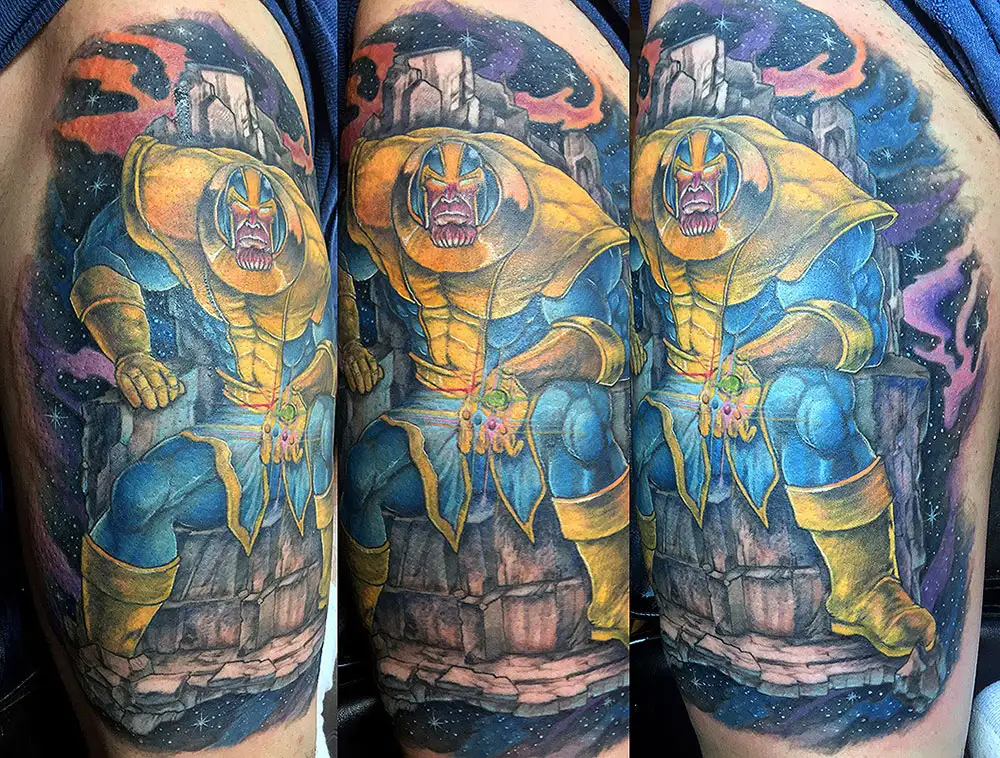
Arm Tattoo | Full Color | comic book Style | Comic tattoo | Marvel Comics
Bold custom color Arm tattoo by Dudes Tattoos in Bronx, NY, portraying Marvel Comics and MCU villain Thanos on a cosmic throne, armored with the glowing Infinity Gauntlet and gems, set in a starry nebula background. A dynamic superhero piece showcasing vibrant details and realism on New York City skin. Contact requests@dudestattoos.com for your custom tattoo.
The Mad Titan: Thanos and His Complex Legacy as Marvel's Philosophical Villain
In the sprawling cosmos of Marvel Comics (the shared universe of superhero stories published by Marvel Entertainment, home to characters like Spider-Man, the Avengers, and the X-Men), no antagonist has captured the imagination quite like Thanos, the self-proclaimed Mad Titan (Thanos's nickname, reflecting his immense power and unhinged yet calculated worldview). Created by writer-artist Jim Starlin (a legendary Marvel creator known for cosmic stories, who drew inspiration from psychology and philosophy) and first appearing in The Invincible Iron Man #55 (cover-dated February 1973), Thanos was born from Starlin’s college psychology musings on death, power, and existential dread. What began as a one-off cosmic threat evolved into one of the medium’s most layered and enduring villains—a being whose “madness” is rooted not in chaos, but in cold, terrifying logic.
Hailing from the Saturnian moon Titan, Thanos is an Eternal (an immortal, superhuman race created by god-like beings called Celestials) cursed with Deviant genes (a divergent, often monstrous offshoot of humanity's evolutionary experiments by the same Celestials, leading to unstable mutations and appearances unlike the perfect Eternals). His purple, wrinkled skin and colossal physique set him apart from his perfect kin, breeding isolation that twisted into an all-consuming obsession with Mistress Death (also known as Death or Lady Death, the cosmic personification of death itself in the Marvel Universe, an abstract entity who can appear as a skeletal figure or a woman). Convinced the universe suffered from overpopulation, Thanos embraced a brutal Malthusian philosophy: only by erasing half of all life could the remaining population thrive. This wasn’t mere villainy—it was, in his mind, mercy. Love for Death and a sincere belief in cosmic balance drove every atrocity.
His early 1970s rampages defined Marvel’s cosmic era. In Starlin’s legendary Captain Marvel run (#25–34), Thanos wielded the Cosmic Cube against Mar-Vell (the original Captain Marvel, a heroic Kree warrior). He clashed with the Avengers, manipulated Adam Warlock (a synthetic superbeing created as the perfect human, a cosmic hero with a soul gem who often opposes Thanos as a philosophical counterpoint), and assembled deadly allies like the Blood Brothers. By the 1980s and 1990s, his schemes grew galactic in scale. The defining moment arrived in 1991 with The Infinity Gauntlet (a landmark 1991 comic miniseries where Thanos collects six powerful Infinity Gems to become god-like), one of comics’ greatest events. Collecting all six Infinity Gems, Thanos snapped his fingers and wiped out half the universe—including countless heroes—to impress Death. Yet even at the pinnacle of omnipotence, doubt crept in. The series peeled back his psyche, revealing regret, loneliness, and a tragic awareness that ultimate power brought only emptiness.
Subsequent epics deepened the complexity. Infinity War (1992) and Infinity Crusade (1993) introduced doppelgangers and divine manipulations. Thanos Quest showed him hunting the Gems with ruthless cunning. In later stories like Thanos: Infinity, Death Sentence, and the 2018 “Thanos Wins” arc, he rules dystopian futures or briefly walks the path of reluctant anti-hero. Starlin’s returns consistently portray him as philosopher-king: intellectually unmatched, strategically brilliant, and capable of moments that blur villain and savior.
What makes Thanos truly singular is his nuance. Unlike one-dimensional destroyers, he grapples with free will versus determinism, quotes cosmic philosophy, and acts from twisted altruism. Freudian analyses even frame his drive as the ultimate “death instinct”—a yearning for oblivion masked as salvation. Starlin has said Thanos reflects humanity’s darkest impulses: the urge to impose order on chaos, no matter the cost. He doesn’t revel in suffering; he calculates it as necessary. That intellectual and emotional depth—combined with raw power that can humble gods—cements him as Marvel’s most compelling antagonist.
Though the MCU streamlined him into a streamlined eco-terrorist, the comic Thanos remains richer: a tragic figure whose love, loss, and conviction force readers to confront uncomfortable truths about sacrifice, ideology, and what any of us might do for the “greater good.” In a universe overflowing with heroes, the Mad Titan endures as proof that the greatest threats are often those who believe, with terrible sincerity, that they are right.